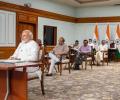
Nivedita Mookerji goes in search of the elusive war room to track and respond to the coronavirus threat.
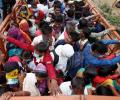
The Centre and state governments are struggling to restart at least some industrial activity as it becomes apparent that the 21-day nationwide lockdown imposed to check the spread of coronavirus disease (Covid-19) could be extended beyond April 14, and stocks of essential commodities need replenishing across the country. State governments, particularly those like Delhi that witnessed an exodus of migrant workers after the lockdown was announced, say there are not enough labourers in the city to work in factories and warehouses.

A single format and simpler, uniform rules would have kept the service going. In other parts of the world including in the US, managing demand and capacities along with ensuring preventive measures were an issue, but there was hardly any administrative hurdle anywhere.
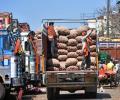
In the last one week several companies have had to face the hurdle of making a distinction between what's essential and what's not. To help them the government has now clarified that grocery would include hygiene products such as hand wash, soaps, disinfectants, body wash, shampoo, surface cleaners, detergents, tissue paper, toothpaste, oral care, sanitary pads, diapers, chargers and battery cells, etc.
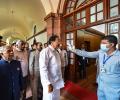
Many feel that the money from their MPLADS should go directly to a district hospital in their respective constituencies rather than a central fund like PM CARES. Archis Mohan reports.
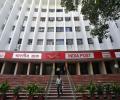
Changing with the times and in compliance with social distancing norms, customers are now picking up their parcels, speed posts and registered letters within the city themselves after they are informed on phone.

Bureaucratic insensitivity gave way to compassion with the state administration, police and passersby joining forces to help the stream of Indians fleeing Delhi.

For 80 years, news and views aired on BBC Hindi reached audiences in the remotest parts of the country. For millions of its followers, the signature line -'yeh BBC hai (this is BBC)' -- has been like a morning alarm, and the bulletins a vital link between India and the world. That link, which began when there was no mobile phone or internet, is about to break as the radio service will fall silent after January 31. And for many living in smaller towns and in rural areas, life won't be the same again, writes Nivedita Mookerji.
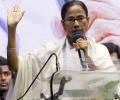
Kerala, Punjab and Rajasthan are the other three states to pass a resolution opposing the contentious legislation, reports Archis Mohan.

Sources said much has been done to ease the tax burden of the middle classes in the last five years, and that such a measure affects only a limited segment of people when the focus should be to put money in rural areas. Archis Mohan reports.

In 2009, the UPA government, had announced a slew of measures to boost liquidity in NBFCs. These included a scheme for providing liquidity support to NBFCs having assets size of over Rs 100 crore through a SPV.

States are planning to pass resolutions in their legislative assemblies; however, such tactics will be used as the last resort if the Centre continues to stall allocations.

Opposition parties, though resigned to the fact that they lack the numbers to defeat or stall the bill in the two Houses, have decided upon different tactics that they would employ to highlight their reasons for opposing it.

Unsure about having the numbers in the Rajya Sabha, the Congress, the Trinamool Congress and other parties have decided they will create awareness about the "divisive" nature of the proposed legislation, reports Archis Mohan.
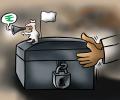
In a resolution passed at its national assembly in Haridwar, the SJM said the Modi government's proposed strategic divestment of PSEs was an "imprudent business decision" and "against national interest".

Though the NITI Aayog did not give its estimates for the required GDP growth at constant prices, economists pegged it at 9 per cent, a feat not seen since the GDP series was revised with 2011-12 as the base year.

As the Congress party prepares to launch protests against the economic slowdown, Chhattisgarh Chief Minister Bhupesh Baghel tells Archis Mohan that his state has escaped its effects as his government has pursued policies that have put money in the pockets of workers, farmers, housewives and tribals, which has helped spur demand.

The 19-year-old partnership ended after the ruling party refused to accede to the ally's demand for 17 of 81 seats.

'RCEP may be in India's long-term interest, but it is certainly not in India's short-term and medium-term interest.'

A small step in this direction was taken with making triple talaq a punishable offence in the last Parliament session. But UCC is difficult to implement, reports Archis Mohan.
 © 2026 Rediff.com - Advertise with us - Disclaimer - Privacy Policy - Sitemap - Feedback - About us - Terms of use - Grievances